
IRS Vehicle Deduction Audit Attorney | Mileage Log & Section 179 Defense
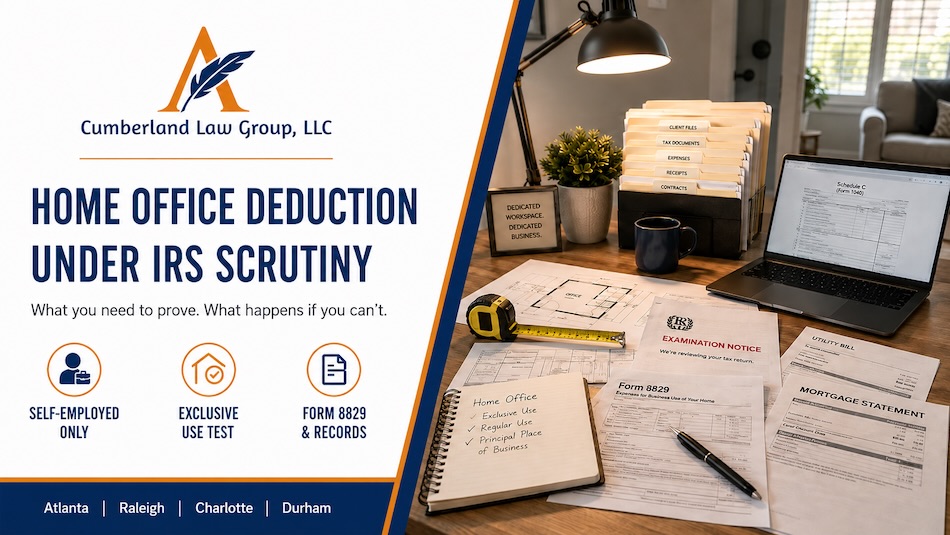
The home office deduction is not a loophole. It is a legitimate tax provision for self-employed people who conduct real business from home. The IRS is not coming after people who follow the rules. It is coming after people who claimed the deduction without understanding what the rules actually require.
That gap between what people assume qualifies and what the IRS actually requires is wide. Millions of remote workers, side-gig operators, freelancers, and small business owners have claimed this deduction based on the general idea that they work from home, without satisfying the specific legal tests that make the deduction defensible in an IRS examination.
When the IRS disallows a home office deduction during an audit, the result can include back taxes at the taxpayer’s marginal rate, a 20% accuracy-related penalty on the underpayment, and interest running from the original filing date. If the deduction was claimed for multiple years, all of those years may be open simultaneously.
The attorneys at Cumberland Law Group, with offices in Atlanta, GA and across North Carolina in Raleigh, Charlotte, and Durham, represent self-employed individuals, independent contractors, freelancers, consultants, and business owners facing IRS examinations where home office deductions are at issue.
If you received an IRS examination notice or correspondence audit letter questioning your home office deduction, call Cumberland Law Group at (800) 960-5359 for a free consultation before responding.
Why the IRS Scrutinizes Home Office Deductions
The home office deduction is frequently misunderstood because the everyday phrase “working from home” is much broader than the tax rule.
For IRS purposes, the question is not simply whether you answered emails from home, took client calls from home, or worked remotely. The question is whether the specific space claimed on the return satisfies the legal requirements for business use of a home.
The IRS evaluates home office deductions through strict requirements, including exclusive use, regular use, principal place of business, and proper documentation. If the taxpayer cannot prove those elements, the deduction may be partially or fully disallowed.
Home office deductions are also commonly reviewed as part of broader IRS tax audits, especially where the taxpayer files Schedule C and claims multiple business deductions that reduce taxable income significantly.
For high-income self-employed taxpayers, the risk is even sharper because IRS systems increasingly compare deduction patterns against statistical norms. Cumberland Law Group has also discussed how IRS AI audits are targeting high-income self-employed taxpayers and Schedule C filers.
Who Qualifies for the Home Office Deduction?
Under current law, the home office deduction generally flows through self-employment, not ordinary W-2 employment.
The Tax Cuts and Jobs Act eliminated the home office deduction for W-2 employees for tax years 2018 through 2025. Current law generally continues to prevent W-2 employees from claiming the home office deduction for unreimbursed employee expenses, even if they work remotely, their employer requires remote work, or their employer does not reimburse them.
That rule is not widely understood. Many employees assumed that working from home after 2020 created a tax deduction. For most W-2 employees, it did not.
Taxpayers who may qualify for the home office deduction include:
- Sole proprietors filing Schedule C
- LLC members taxed as sole proprietors or partnerships
- Independent contractors and freelancers
- Partners with unreimbursed home office expenses attributable to partnership activity, where allowed
- Self-employed individuals who also hold a W-2 job, but only for the self-employed portion of their work
A W-2 employee who also runs a side business may be able to claim the home office deduction for the self-employed business, but only if the space is used exclusively and regularly for that self-employed business, not for W-2 employment.
The IRS explains the general requirements in IRS Topic No. 509, Business Use of Home and IRS Publication 587.
The Exclusive Use Test: Where Most Claims Fail
The exclusive use requirement under IRC Section 280A is strict. The claimed space must be used only for business. Not primarily. Not mostly. Only.
A desk in the corner of a living room where the family also watches television fails the test. A bedroom that occasionally hosts guests fails the test. A kitchen table where you work during business hours fails the test because the kitchen serves personal purposes at other times. A dedicated room that a spouse or child also uses for personal activities can fail the test.
The IRS does not necessarily require a permanently partitioned space. A home office can be a portion of a larger room, but the business portion must be used exclusively for business.
This is not a proportional allocation rule. It is a pass/fail requirement. Any personal use of the claimed space can put the deduction at risk.
Common scenarios that fail include:
- A home office where a treadmill, television, or gaming system is also kept
- A room used as an office during the week and a guest bedroom when family visits
- A workspace used by a spouse or child for personal activities
- A desk in a common area of the home where family members regularly move through
Common scenarios that may pass, with proper documentation, include:
- A dedicated room with a door, used only for business operations, with no personal items present
- A portion of a basement or garage configured exclusively for business use
- A separate detached structure, studio, or garage apartment used solely for business activity
Regular Use and Principal Place of Business
Exclusive use alone does not complete the qualification analysis. The space must also be used regularly and must satisfy one of the business-use tests.
Regular use means consistent, ongoing business use, not occasional or incidental work. Working from a home office once or twice a month is not the same as using the space as a central and regular part of your business operations.
Principal place of business has a specific meaning. A home office may qualify if it is where you conduct substantial administrative and management activities of your business and there is no other fixed location where you conduct those activities.
For example, a contractor who performs work at client job sites may still qualify if billing, scheduling, recordkeeping, estimating, and client communication are regularly handled from the home office and there is no other office where those administrative activities occur.
The client meeting alternative may also apply. If you regularly and exclusively use the space to meet clients, patients, or customers in the normal course of business, the space may qualify even if the home office is not the principal place of business under the administrative activity test.
The key is regular, documented business use. Occasional convenience is not enough.
Simplified Method vs. Actual Expense Method
There are two main ways to calculate the home office deduction: the simplified method and the actual expense method.
Simplified Method
The simplified method generally allows a deduction of $5 per square foot of dedicated office space, capped at 300 square feet. That creates a maximum deduction of $1,500 per year.
This method is straightforward. It requires a record of the office square footage and the total square footage of the home, but it does not require allocating actual home expenses or claiming depreciation.
The IRS provides more detail on the simplified option for home office deduction.
Actual Expense Method
The actual expense method is usually reported on Form 8829. It applies the business percentage of the home to eligible indirect expenses such as rent, mortgage interest, real estate taxes, utilities, homeowners insurance, and general repairs.
Direct expenses related only to the office space may be deductible in full. Depreciation on the business portion of the home may also be available.
The actual expense method often produces a larger deduction, but it comes with more recordkeeping and a potential future issue: depreciation recapture.
When depreciation is claimed under the actual expense method, that depreciation may be subject to recapture when the home is sold. The simplified method avoids depreciation recapture for years in which it is used because no depreciation is claimed.
That does not mean the simplified method is always better. It means the calculation should be made with an understanding of both current tax benefit and future tax consequences.
What the IRS Looks for During a Home Office Audit
Home office deductions appear on Form 8829 or through the simplified method calculation tied to Schedule C.
The IRS may review whether the claimed space actually qualifies, whether the square footage is accurate, whether the expenses were calculated correctly, and whether the deduction fits the taxpayer’s business activity.
Specific patterns that can increase audit risk include:
- Claiming a home office percentage larger than the actual dedicated workspace supports
- Home office square footage that changes significantly from year to year without explanation
- W-2 income alongside a home office claim, especially where Schedule C activity is weak or unclear
- Actual expense method claims where the office represents a large share of the home
- Home office deduction combined with other Schedule C deductions that create losses or near-zero profit
- Claims that do not match the actual layout or use of the home
The IRS may request floor plans, square footage calculations, photos, utility bills, rent or mortgage records, business records, appointment logs, and evidence showing that the space was used exclusively and regularly for business.
If a home office deduction is part of a broader Schedule C examination, the IRS may also review vehicle expenses, travel, meals, supplies, contractor payments, and other business deductions. If your audit also involves business mileage, review our guide to IRS vehicle deduction audits.
What Disallowance Actually Costs
When an IRS examiner determines that a home office claim fails the exclusive use test, regular use test, principal place of business requirement, or documentation requirement, the deduction may be disallowed.
The financial consequence usually has three parts.
Back Taxes
The disallowed deduction is added back to taxable income. If a taxpayer in the 24% marginal bracket claimed $8,000 in home office deductions over two years, disallowance could produce roughly $1,920 in additional federal tax, before state tax, penalties, and interest.
Accuracy-Related Penalty
Under IRC Section 6662, the IRS may assess a 20% accuracy-related penalty on an underpayment attributable to negligence, disregard of rules, or substantial understatement.
Home office disallowance can meet this threshold when multiple years are examined or when the deduction is large compared to the taxpayer’s income.
Interest
Interest runs from the original due date of the return. For deductions claimed several years ago, interest can become significant.
Where the IRS believes deductions were fabricated or claimed fraudulently, the issue can become more serious. The civil fraud penalty under IRC Section 6663 is 75% of the underpayment attributable to fraud.
If the IRS is questioning whether records were fabricated or whether deductions were knowingly false, speak with a tax attorney before making statements to the examiner. Cumberland Law Group handles tax fraud and criminal tax defense matters.
For a deeper explanation of how these charges add up, see our guide to IRS penalties and interest.
What to Do If You Overclaimed the Deduction
If you review prior year returns and discover that the home office deduction claimed does not meet the exclusive use test, was claimed as a W-2 employee, or overstated the square footage, your options depend on whether the IRS has already contacted you.
Before IRS Contact
Before any IRS contact, filing an amended return may correct the record. An amended return filed voluntarily before examination may reduce penalty exposure, especially where the taxpayer has a clean compliance history and acted before the IRS opened an audit.
However, the decision to amend should be made carefully. You need to know which years are still open, how much tax is involved, whether penalties may apply, and whether the correction creates other issues.
After IRS Contact
Once a CP2000 notice, examination notice, or correspondence audit letter has arrived, the issue has changed. The IRS is already aware of a potential problem. The response is no longer simply a voluntary correction. It is now an examination response.
At that stage, the taxpayer should focus on building the record, preserving defenses, responding accurately, and avoiding statements that make the problem worse.
If the IRS proposes an adjustment and you disagree, you may have appeal rights. Learn more about appealing an IRS assessment.
For taxpayers deciding who should handle the response, read our guide on Tax Attorney vs. CPA.
Documentation That Survives an IRS Examination
An examiner reviewing a home office claim will ask for specific documentation. Having it prepared before an audit notice arrives can make the difference between a straightforward resolution and a months-long dispute.
Documents that may support a home office deduction include:
- A floor plan or hand-drawn sketch showing the entire home’s square footage and the specific area claimed as the home office
- Measurements showing the office square footage and total home square footage
- Dated photographs of the home office space showing business-only configuration
- Utility bills, rent statements, mortgage interest records, property tax records, and homeowners insurance records for actual expense claims
- Business records showing the work performed in the home office
- Client files, appointment logs, contracts, invoices, and business bank statements
- Records of client meetings at the home, if that is part of the claimed use
- Form 8829 and calculation worksheets for the year or years under examination
Contemporaneous records are usually stronger than records created after the audit notice arrives. A dated photo from the tax year at issue may carry more weight than a photo taken after the room was reconfigured for audit purposes.
The goal is to show that the claimed space was both real and legally qualified during the year under examination.
Georgia and North Carolina Home Office Audits
Atlanta has a large population of consultants, creative professionals, independent contractors, and service-based business owners who work primarily from home. That makes home office deduction audit risk a real issue for Georgia taxpayers.
Raleigh, Durham, and Charlotte also have high concentrations of remote technology workers, consultants, freelancers, and self-employed professionals.
The key distinction is employment status. A W-2 remote employee generally cannot claim the deduction. A self-employed consultant, contractor, or business owner may be able to claim it if the home office satisfies the exclusive use, regular use, and principal place of business requirements.
Self-employed taxpayers in Georgia and North Carolina who claimed home office deductions for spaces that also served personal purposes, such as bedrooms, kitchens, living rooms, or guest rooms, face the greatest risk of disallowance if examined.
Frequently Asked Questions About Home Office Deduction Audits
Can W-2 employees claim the home office deduction?
No. Under current law, W-2 employees generally cannot claim the home office deduction for unreimbursed employee expenses, even if they work remotely.
What is the exclusive use test?
The exclusive use test requires the claimed home office space to be used only for business. A room or area used for both business and personal purposes generally fails the test.
What happens if the IRS disallows my home office deduction?
The IRS may add the disallowed deduction back to taxable income, assess additional tax, add interest, and impose a 20% accuracy-related penalty if the underpayment is substantial or negligent.
Is the simplified home office method safer?
The simplified method may reduce recordkeeping and avoids depreciation recapture for years it is used, but the taxpayer must still satisfy the exclusive use, regular use, and principal place of business rules.
What documents help defend a home office deduction?
Useful records include floor plans, square footage calculations, dated photos, utility bills, rent or mortgage records, Form 8829, client records, appointment logs, and proof that the space was used exclusively and regularly for business.
Free Consultation with Cumberland Law Group
If you received an IRS examination notice or correspondence audit letter that references your home office deduction, or if you have questions about prior year returns where the claimed deduction may not meet the exclusive use test, contact Cumberland Law Group before responding to the IRS.
We represent self-employed individuals, independent contractors, freelancers, consultants, and business owners across Georgia and North Carolina in Schedule C examinations, home office audits, and proposed assessments involving disallowed deductions.
Free consultations are available at our offices in:
Do not wait until the IRS disallows the deduction and adds penalties. The earlier the audit record is built correctly, the more options you may have.
Call Cumberland Law Group at (800) 960-5359 for a free consultation, or contact us online and we will call you back.
This page is for informational purposes only and does not constitute legal advice. Contact Cumberland Law Group directly for guidance specific to your situation.