
1099-K CP2000 Notice Attorney | PayPal, Venmo & Cash App IRS Help
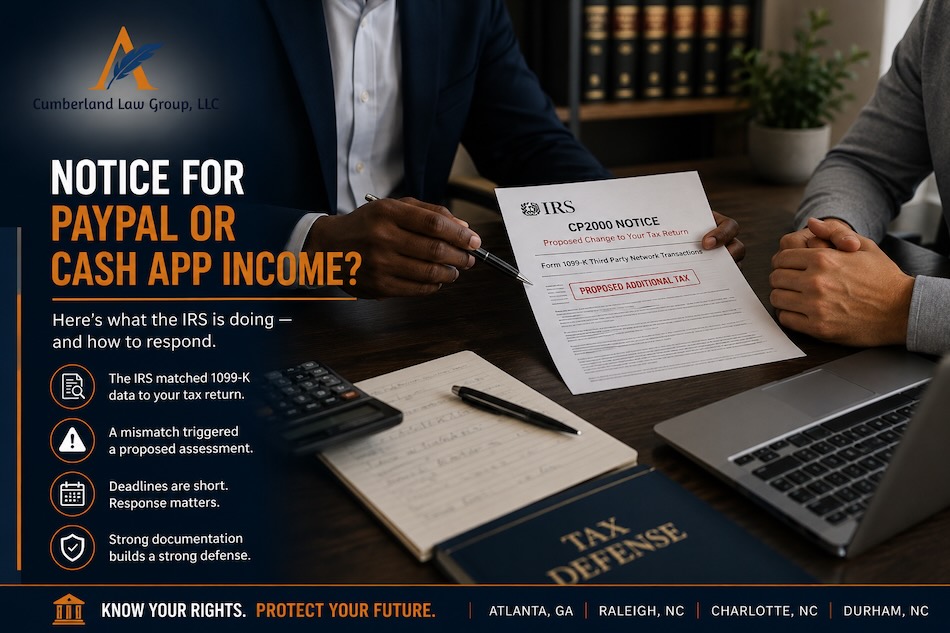
If you received a CP2000 or audit notice referencing income reported on Form 1099-K from Venmo, PayPal, Cash App, Square, Etsy, eBay, or another payment platform, the IRS did not guess. It ran a match.
A computer compared the amount the platform reported to the IRS against what appeared on your tax return. If the numbers did not line up, the IRS may have issued a proposed tax assessment.
That proposed assessment can include additional tax, interest, a potential 20% accuracy-related penalty, and a response deadline that is already running.
The defense angle matters here, and it is often missing from basic articles explaining what a 1099-K is. This page is for taxpayers who are already past the informational stage. The notice has arrived, and the question is what to do about it.
The tax attorneys at Cumberland Law Group, with offices in Atlanta, GA and across North Carolina in Raleigh, Charlotte, and Durham, handle IRS correspondence audits, CP2000 notices, and proposed assessments involving 1099-K data.
If you received a CP2000 notice for PayPal, Venmo, Cash App, Square, Etsy, eBay, or other platform income, call Cumberland Law Group at (800) 960-5359 for a free consultation before you respond.
How the IRS Found You: The Automated Underreporter System
The IRS does not manually review every tax return looking for unreported PayPal income. It uses a program called the Automated Underreporter system, often called AUR, to identify income mismatches at scale.
Here is how it works: every platform that sends you a Form 1099-K also sends a copy to the IRS. Venmo files it. PayPal files it. Cash App files it. Square files it. Online marketplaces and payment processors file it.
The AUR system then cross-references that third-party data against your filed tax return.
When the amount reported on your 1099-K does not match your reported income to the IRS’s satisfaction, the IRS may issue a CP2000 notice proposing additional tax based on the discrepancy.
The problem is that the AUR system is not sophisticated about context. It sees a number reported by the platform and compares it against what appears on your return. It does not automatically know:
- Whether the payments were personal reimbursements from friends
- Whether you already reported the income on a different line of your return
- Whether the 1099-K reflects gross proceeds rather than taxable income
- Whether state reporting thresholds caused the form to be issued
- Whether the platform misclassified personal transactions as business transactions
Each of those scenarios can create a mismatch that looks identical to genuine unreported income. The IRS notice may be based on incomplete context, bad platform data, or a reporting issue that can be corrected with the right documentation.
Why 1099-K Notices Are Landing in Mailboxes Now
The 1099-K reporting threshold has changed multiple times in recent years. That timeline explains why many taxpayers are receiving notices now and which tax years may create risk.
| Tax Year | Federal 1099-K Threshold | Who Commonly Received 1099-Ks |
|---|---|---|
| 2022 | $20,000 and 200+ transactions | High-volume sellers, freelancers, and payment platform users |
| 2023 | $20,000 and 200+ transactions | Same general population because the IRS delayed the $600 rule |
| 2024 | $5,000 in payments, with no minimum transaction count | A much wider group of freelancers, sellers, and service providers |
| 2025 forward | $20,000 and 200+ transactions | Back to the pre-2024 federal threshold for third-party settlement organizations |
The 2024 tax year is especially important. The $5,000 threshold applied that year, which meant a much larger group of people received Form 1099-K for the first time.
Freelancers, side gig workers, marketplace sellers, consultants, contractors, and small service providers who had never received a 1099-K before may have received one in early 2025 for their 2024 activity.
If the taxpayer did not know the form was coming, did not receive it, or did not report the income properly on the 2024 return, the IRS matching system may identify a discrepancy and issue a CP2000 notice.
The One Big Beautiful Bill Act restored the $20,000 and 200-transaction threshold for 2025 forward. That may reduce future 1099-K reporting exposure for many taxpayers, but it does not automatically fix 2024 returns that already created a mismatch.
Five Defense Scenarios: When the IRS Notice Is Wrong
A CP2000 proposing additional tax is a proposal, not a final assessment. It can be disputed. In many 1099-K cases, the proposed tax is incorrect, overstated, or missing important context.
1. Personal Reimbursements Tagged as Business Payments
Payment apps often allow users to identify a payment as goods and services or friends and family. When someone pays you back for dinner, travel, rent, or a shared expense and incorrectly tags the payment as goods and services, the platform may treat that transaction as reportable income.
The IRS then receives a 1099-K that includes amounts that were not actually income. Your return does not include them because they were personal reimbursements. The AUR system sees a mismatch.
Defense: Documentation showing that the payments were personal reimbursements, not payment for goods or services. Bank records, payment descriptions, text messages, invoices, receipts, and a written explanation can help establish the correct treatment.
2. The Gross Proceeds Problem
Form 1099-K reports gross payments received through the platform. It does not subtract platform fees, refunds, shipping costs, cost of goods, supplies, or other business expenses.
A seller who received $30,000 in gross payments through Etsy, eBay, Square, PayPal, or another platform may have far less taxable income after expenses. If the taxpayer reported net income rather than reconciling gross receipts properly, the IRS may treat the difference as unreported income.
Defense: A properly completed Schedule C showing gross receipts, expenses, and net profit. The response should reconcile the 1099-K amount and show the IRS why the proposed assessment overstates the taxable income.
3. Income Already Reported on a Different Line
A freelancer may have reported all income on Schedule C but did not separately label the PayPal or Cash App portion. For example, the return might show $45,000 in total gross receipts, including $18,000 from PayPal. The 1099-K shows $18,000, but the IRS matching system may not connect that amount to the total already reported.
This is often a documentation problem, not a true underreporting problem.
Defense: Annotated copies of the filed return, bookkeeping reports, bank records, and a reconciliation showing where the 1099-K income was already included.
4. State Threshold Mismatches
Some states have had lower 1099-K reporting thresholds than the federal standard. A taxpayer may receive a 1099-K because a platform complied with state reporting requirements, even if the amount was below the federal reporting threshold for that year.
The IRS may still receive the form and match it against the federal return.
Defense: Identify why the 1099-K was issued, determine whether the amount was taxable income, and respond with documentation of the correct federal tax treatment.
5. The Platform Got It Wrong
Payment platforms make mistakes. A 1099-K may report the wrong amount, include personal transactions, use the wrong taxpayer identification number, or attribute payments to the wrong person or business.
If the platform reported incorrect information, the CP2000 may be based on bad data.
Defense: Request a corrected 1099-K from the platform. Then submit the corrected form, transaction records, and a written explanation to the IRS.
If your notice involves more than one of these issues, do not respond with a generic explanation. A strong CP2000 response addresses the IRS’s proposed changes line by line.
What Happens If You Ignore the CP2000 Notice?
A CP2000 is not the final word. It is a proposed change. But ignoring it can move the case quickly toward assessment and collection.
The standard escalation path may look like this:
| IRS Stage | What It Means | Why It Matters |
|---|---|---|
| CP2000 Notice | Proposed assessment based on third-party income mismatch | Usually the cheapest and best stage to dispute the issue |
| CP3219A Notice of Deficiency | Statutory notice giving the taxpayer 90 days to petition Tax Court | Missing this deadline can eliminate Tax Court review before assessment |
| IRS Assessment | Tax, interest, and penalties are officially assessed | The taxpayer is now fighting an assessed debt instead of a proposal |
| Collection Notices | CP501, CP503, CP504, LT11, or related notices | The case can move toward lien, levy, or garnishment |
| Levy or Garnishment | IRS collection action against income or accounts | Bank accounts, wages, or receivables may be at risk |
The IRS generally asks taxpayers to respond to a CP2000 within 30 days from the notice date. If you live outside the United States, the response period may be longer.
Once the IRS assesses the tax, the issue becomes harder and more expensive to unwind. The taxpayer may then need to pursue audit reconsideration, penalty abatement, refund procedures, or collection alternatives.
If collection has already started, review Cumberland Law Group’s resources on bank levies, wage garnishment, and federal tax liens.
How to Build a CP2000 Response That Actually Works
A CP2000 response that simply says “I disagree” usually does not accomplish much. The response needs to address the specific items the IRS identified and provide documentation supporting a different conclusion.
A strong response should include:
- The IRS response form, marked to show disagreement where appropriate
- A written explanation of why the proposed changes are incorrect or overstated
- Documentation organized by issue
- A reconciliation between the 1099-K, the tax return, and the taxpayer’s records
- Any corrected 1099-K, platform records, or business expense documentation
Documentation varies by defense scenario:
- Personal reimbursements: bank records, payment descriptions, screenshots, messages, and written explanation
- Gross versus net income: Schedule C, platform reports, expense records, receipts, and bookkeeping records
- Already reported income: filed return, annotated schedules, gross receipts reports, and reconciliation
- Platform errors: corrected 1099-K, platform correspondence, account history, and transaction records
One common mistake is paying the CP2000 amount immediately without reviewing it. Payment may be treated as agreement with the proposed changes. Getting a refund later may be possible, but it is often slower and more complicated than disputing the proposal before payment.
A second common mistake is confirming the 1099-K income without also accounting for legitimate business expenses. A taxpayer who reports the gross 1099-K amount but fails to claim associated deductions may overpay.
Before responding, it may help to understand how IRS audits, IRS notices, and IRS penalties and interest work together.
For Georgia and North Carolina Taxpayers: What Is Different?
Georgia does not have a state-specific lower 1099-K threshold and generally follows federal rules. North Carolina also generally aligns with federal thresholds for state income tax purposes.
That means for 2024 returns, taxpayers in Georgia and North Carolina were primarily affected by the federal $5,000 threshold for Form 1099-K reporting.
Freelancers, marketplace sellers, consultants, and small service providers in Atlanta, Raleigh, Charlotte, and Durham who received $5,000 or more through payment platforms in 2024 may be in the primary risk population for CP2000 notices tied to 1099-K data.
The Research Triangle has a large concentration of independent technology contractors, designers, consultants, and professional service providers who receive platform payments. The Atlanta market includes many service-based businesses, event professionals, trades, personal services, and independent sellers who increasingly collect payments through apps.
Many taxpayers in these groups did not typically receive Forms 1099-K before 2024. Some received one for the first time in 2025 for 2024 activity.
If that describes your situation, the relevant question is not always whether the income was taxable. The question is whether the amount the IRS is proposing is accurate, whether the income was already reported, and whether deductible business expenses were properly claimed.
When a Tax Attorney Should Get Involved
A 1099-K CP2000 notice may look simple, but it can quickly turn into a larger tax controversy if the response is incomplete, late, or inaccurate.
A tax attorney can help determine:
- Whether the IRS proposal is correct
- Whether the 1099-K includes non-taxable personal transactions
- Whether the income was already reported elsewhere on the return
- Whether business expenses were omitted or underclaimed
- Whether penalty defenses are available
- Whether an amended return, CP2000 response, audit response, or other procedure is appropriate
For taxpayers deciding whether to use a CPA or attorney, read our guide on Tax Attorney vs. CPA. Once an IRS notice has arrived, attorney-client privilege and legal strategy may matter.
If the proposed assessment is large, if the IRS has added penalties, or if the notice involves multiple tax years, speak with a tax attorney before responding.
Schedule Your Free Consultation with Cumberland Law Group
If you received a CP2000 or any IRS notice related to income from Venmo, PayPal, Cash App, Square, Etsy, eBay, Stripe, Shopify, or another payment platform, the response window is already running.
Cumberland Law Group represents individuals and business owners in Georgia and North Carolina facing IRS correspondence audits, examination notices, proposed assessments, and collection actions based on Form 1099-K data.
We review the notice, assess whether the proposed amount is accurate, identify applicable deductions and defenses, and prepare responses that address the IRS’s position item by item.
Free consultations are available at our offices in:
Do not respond to an IRS notice without reviewing the underlying data first.
Call Cumberland Law Group at (800) 960-5359 for a free consultation, or contact us online and we will call you back.
This page is for informational purposes only and does not constitute legal advice. Contact Cumberland Law Group directly for guidance specific to your situation.