
IRS Tax Liens on Businesses: What Most Owners Don't Know Until It's Too Late
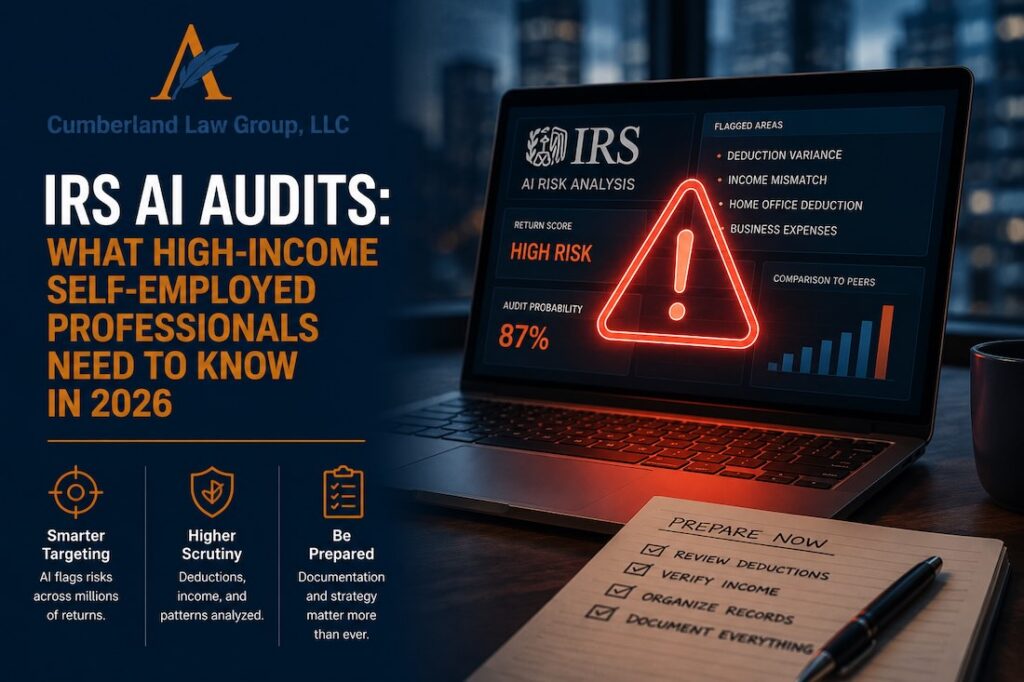
The IRS no longer needs a team of agents to find you. It has an algorithm — and it runs six times a year.
If you’re self-employed, pulling in high six or seven figures, and filing a Schedule C, you’re in one of the most heavily targeted taxpayer groups in 2026. The IRS has rebuilt its enforcement infrastructure around artificial intelligence. And the tax professionals at Cumberland Law Group — with offices in Atlanta, GA and across North Carolina in Raleigh, Charlotte, and Durham — are seeing the consequences play out in real time for clients who had no idea they were on the agency’s radar.
Here’s what’s happening, why it matters to you specifically, and what you need to do before a notice shows up in your mailbox.
The IRS Is Not the Same Agency It Was Three Years Ago
Between January 2024 and early 2026, the IRS cut its workforce by roughly 25% — dropping from approximately 103,000 employees to around 77,000. That includes a meaningful share of experienced revenue agents, the ones who historically handled complex, high-income audits.
At the same time, the agency quietly moved from pilot programs to full deployment of AI-powered audit selection. The result: fewer human auditors, but dramatically more sophisticated targeting.
The IRS now runs machine learning models across millions of returns simultaneously. These systems score returns for audit potential, cross-reference third-party data, and compare your numbers against statistical norms for your income bracket. According to a May 2025 Treasury Inspector General for Tax Administration (TIGTA) report, the IRS’s Small Business/Self-Employed Division deployed a dedicated AI model specifically to analyze returns already flagged by the older Discriminant Index Function (DIF) system — then go deeper on each individual line item.
The older DIF compared numbers against historical averages. The new AI models do something more unsettling: they analyze patterns across your entire tax history, flag year-over-year deviations, and score every line item against what the algorithm “expects” to see for someone in your situation.
If you’ve already received an IRS notice or letter and aren’t sure what triggered it, call Cumberland Law Group at (800) 960-5359 for a free consultation before you respond to anything.
Why Self-Employed Professionals Are the Primary Target
The IRS has a term for uncollected taxes: the “tax gap.” The most recent estimates put that gap at roughly $696 billion per year (2022 data). Self-employment income is the single largest contributor to the individual side of that number.
The reason is structural, not accusatory. Unlike W-2 employees, self-employed professionals control both sides of the equation — what income gets reported and what expenses get deducted. There’s no employer withholding, no W-2 cross-reference. For decades, that meant a higher margin for error and, frankly, a higher margin for aggressive filing positions.
AI changes that equation fast. The IRS now matches 1099-NEC and 1099-K forms against your reported income with near-perfect accuracy. It cross-references public records — property ownership, vehicle registrations — against what you claim to earn. And with Form 1099-DA rolling out in 2026 for cryptocurrency transactions, previously invisible income streams are now fully visible to the algorithm.
Three groups face the sharpest scrutiny heading into 2026:
- High-income self-employed individuals — particularly those earning above $400,000–$500,000
- Schedule C filers with business deductions that fall outside industry norms
- Pass-through entity owners — S-Corps, LLCs, partnerships — with complex income structures
If you fall into more than one of these categories, the odds of an automated flag are not theoretical. Understanding how IRS audits work — and what triggers them — is the first line of defense.
What Triggers the AI: The 7 Highest-Risk Scenarios
Understanding how the algorithm flags returns is the first step to managing your exposure. These are the patterns that consistently draw attention in 2026:
1. Deduction Ratios That Exceed Benchmarks
The IRS knows what someone in your industry, at your income level, typically deducts. When your Schedule C deductions are significantly higher than the statistical norm — even if every number is legitimate — your DIF score rises. The AI then applies a secondary pass to identify the specific line items driving the deviation.
2. Recurring Business Losses
Reporting a business loss for three or more out of five consecutive years triggers the “hobby loss” question. The IRS may challenge whether the activity qualifies as a trade or business under IRC Section 183. This is especially common for high-W-2-income filers who also claim Schedule C losses, because the offset creates a tax benefit the system is specifically designed to scrutinize.
3. Home Office Deductions — Particularly With a W-2
A home office deduction is legitimate under the right conditions — but the space must be used exclusively and regularly for business. Filing a home office claim alongside W-2 income from an employer remains one of the most reliably flagged combinations in automated review.
4. Vehicle and Travel Deductions Without Documentation
100% business use of a vehicle is a statistical rarity. When a return claims it — especially for high-income filers — the AI flags the deviation from norms. Meal and entertainment deductions that seem disproportionate to the reported revenue of the business also score high for anomaly.
5. Income That Doesn’t Match Third-Party Reporting
The automated underreporter program (AUR) compares your return against every information return on file — W-2s, 1099s, K-1s, brokerage statements. In 2026, this matching now includes Form 1099-DA for crypto. If the numbers don’t match exactly, the mismatch triggers an automated notice before a human being ever reads your return.
6. Round Numbers Throughout the Return
Expenses like “$5,000 in office supplies” or “$12,000 in travel costs” with no variation signal estimates rather than actual records. The AI is specifically calibrated to flag returns where multiple line items are round numbers, treating it as an indicator of poor documentation or fabricated expenses.
7. Year-Over-Year Income Swings
A significant income drop — or spike — compared to prior years triggers pattern deviation scoring. If your reported income drops 40% from one year to the next while your apparent lifestyle stays consistent, the algorithm takes note. This is one of the primary ways the IRS uses the net worth and bank deposit analysis methods to reconstruct unreported income.
See yourself in more than one of these scenarios? Call (800) 960-5359 for a free consultation with Cumberland Law Group. The earlier you get representation involved, the more options you have. Here’s why a tax attorney provides protections a CPA cannot once the IRS has flagged your return.
What Happens After You’re Flagged
Getting flagged by the AI does not automatically mean a full audit. The algorithm scores returns; humans — or further automated processes — then prioritize which flagged returns receive attention.
There are three likely outcomes once a flag occurs:
| Outcome | Description | What to Do |
|---|---|---|
| CP2000 Notice | Automated notice for income discrepancies — income reported by third parties doesn’t match your return | Do not ignore. Get attorney review before responding. Deadlines are firm. |
| Correspondence Audit | IRS requests documentation for specific line items by mail | Your response defines the scope of what the IRS can ask for next. Audit defense guidance here. |
| Field or Office Audit | A revenue agent is assigned; in-person examination of records | High-income, complex returns land here. Representation is not optional at this stage. |
The AI selects. The channel — correspondence, office, or field — generally depends on the complexity of the issues flagged. High-income returns with complex structures tend to land in the field audit category.
One critical point: missing a response deadline, even on a routine CP2000, can result in automatic assessment of the proposed tax. The IRS doesn’t wait long. If you’ve received any notice and aren’t sure what it means, start here — then call (800) 960-5359 before the deadline passes.
How to Reduce Your Exposure Now
Filing cleanly is not enough in 2026. The AI doesn’t reward good intentions — it rewards documentation and consistency.
Before you file:
- Reconcile every 1099-NEC, 1099-K, 1099-DIV, and K-1 against your own records before the return goes in. A mismatch you spot beats a notice you didn’t.
- If you have cryptocurrency transactions, reconcile 1099-DA gross proceeds against your transaction log and calculate cost basis with a consistent methodology.
- Review your deduction ratios. A tax attorney who understands your industry can tell you where your numbers fall against benchmarks — before the algorithm does.
- If you claim a home office or vehicle deduction, your documentation should be contemporaneous, not reconstructed. Mileage logs, dated receipts, and business purpose records kept in real time carry far more weight than a spreadsheet assembled after the fact.
If your return is already filed:
- If you suspect a line item may draw scrutiny, having representation in place before a notice arrives is far cheaper than finding representation after one does.
- Do not respond to an IRS notice without professional review. What you say — or don’t say — in a response to a correspondence audit affects the scope of what the IRS can ask for next.
- If prior year returns are unfiled, those gaps are visible to the algorithm and create compounding exposure. Getting current before the IRS finds the gap matters.
- If you have unpaid back taxes alongside current filing risk, those need to be addressed together — not sequentially.
For a full breakdown of how IRS penalties and interest compound once a notice issues, see our guide. And if penalty exposure is already on the table, first-time penalty abatement may be available — but only if you act before the assessment becomes final.
Why Representation Matters More in an AI-Driven Enforcement Environment
There’s a common misconception that AI enforcement is more objective than human enforcement. It isn’t — it’s just faster. An algorithm that flags your return based on a deviation from statistical norms doesn’t know that your deductions are fully documented, that your business had an unusual year, or that your industry operates differently from the benchmark population.
A tax attorney does know that. And they know how to present it in a way the IRS will accept.
The audit process has a formal appeals structure that most self-employed professionals never use — because they don’t know it exists until it’s too late. Understanding when and how to appeal IRS assessments is a core part of what representation provides. So is knowing when a negotiated settlement or an Offer in Compromise is the right path versus a full audit defense.
There is also a harder edge to this. If an audit uncovers patterns that cross from aggressive filing into what the IRS characterizes as fraud or evasion, the stakes change entirely. The IRS’s Criminal Investigation division is active, well-funded, and specifically targeting high-income self-employed filers in 2026. An attorney provides the privilege protections a CPA cannot — from the first conversation forward.
The algorithm is running. The question is whether you’re ready for it. Call Cumberland Law Group at (800) 960-5359 for a free consultation — available Mon–Sun, 9am–9:30pm.
Schedule Your Free Consultation with Cumberland Law Group
Cumberland Law Group represents high-income self-employed professionals, business owners, and entrepreneurs across the Southeast. Our attorneys work directly with Schedule C filers, pass-through entity owners, and high-earners facing CP2000 notices, correspondence audits, and full field examinations — from first notice through resolution.
We offer free consultations. Our offices:
- Atlanta, GA — 400 Galleria Pkwy #1500
- Raleigh, NC — 421 Fayetteville St Suite 1100
- Charlotte, NC — 6201 Fairview Rd Suite 200
- Durham, NC — 555 S. Mangum Street, Suite 100
If you’ve received an IRS notice, are preparing a return you have questions about, or want to understand how the 2026 AI enforcement environment applies to your specific situation — call us. The earlier you involve representation, the more options you have.
Call (800) 960-5359 for a free consultation, or submit your information online and we will call you back.
This article is for informational purposes only and does not constitute legal advice. Contact Cumberland Law Group directly for guidance specific to your situation.