
IRS Vehicle Deduction Audit Attorney | Mileage Log & Section 179 Defense
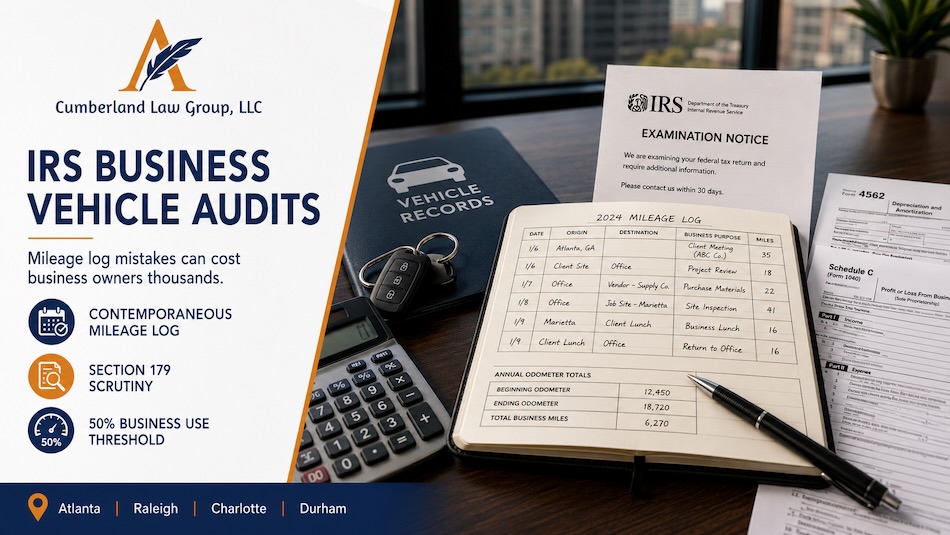
Vehicle deductions sit near the top of the IRS’s Schedule C audit priority list. The reason is straightforward: vehicle expenses are easy to overclaim, difficult to substantiate without proper records, and almost always involve some personal use that taxpayers fail to exclude.
The IRS knows this. Its examination procedures for vehicle deductions are detailed and specific. When an examiner opens a Schedule C with vehicle deductions, the standard document request usually includes a mileage log, odometer readings, business purpose for each trip, and the total personal versus business breakdown for the year.
What examiners often receive is something that does not hold up: reconstructed records, round numbers, commuting miles counted as business miles, or no mileage log at all.
The tax attorneys at Cumberland Law Group, with offices in Atlanta, GA and across North Carolina in Raleigh, Charlotte, and Durham, represent self-employed professionals, contractors, S-Corporation owners, and business owners whose vehicle deductions are under IRS examination.
If you received an IRS audit notice questioning mileage logs, business vehicle expenses, Section 179, or Schedule C vehicle deductions, call Cumberland Law Group at (800) 960-5359 for a free consultation before responding.
Why Vehicle Deductions Are a Top IRS Audit Target
Business vehicle deductions are one of the easiest deductions to claim and one of the hardest to defend without proper substantiation.
The IRS knows that many taxpayers use the same vehicle for business and personal purposes. That mixed-use reality creates audit risk because only the business portion is deductible.
When the IRS reviews a vehicle deduction, the examiner is not just looking at whether the vehicle was used for work. The examiner is looking for contemporaneous records showing the date, destination, mileage, and business purpose of each trip.
If the deduction was claimed on a Schedule C, partnership return, or S-Corp return, the IRS may request supporting records, receipts, mileage logs, odometer readings, depreciation schedules, and the vehicle purchase or lease agreement.
For a broader overview of how these examinations work, review Cumberland Law Group’s guide to IRS tax audits.
Standard Mileage vs. Actual Expense Method
Every business vehicle deduction starts with a choice: standard mileage rate or actual expense method. That choice can have long-term consequences.
The standard mileage method allows a taxpayer to deduct a fixed amount for each qualified business mile driven. The actual expense method deducts the real costs of operating the vehicle in proportion to business use, including fuel, insurance, registration, repairs, maintenance, depreciation, and related expenses.
The IRS publishes the standard mileage rates each year. For some taxpayers, the standard mileage method is simpler and easier to substantiate. For others, especially taxpayers using expensive vehicles with high operating costs, the actual expense method may produce a larger deduction.
The election matters because of what it can close off.
If you claim Section 179 expensing or bonus depreciation on a vehicle in the first year, you are generally committed to the actual expense method for that vehicle. The standard mileage rate is no longer available for that vehicle going forward.
If you use the standard mileage rate in the first year, you may be able to switch to actual expenses in a later year, but depreciation limitations may apply.
For leased vehicles, the standard mileage rate election generally must be maintained for the entire lease period, including renewals.
Section 179 and Bonus Depreciation Vehicle Audits
Section 179 allows immediate expensing of qualifying vehicle costs rather than depreciating them over multiple years. Bonus depreciation may also apply to certain vehicles, depending on the year, the vehicle, the business use percentage, and the applicable tax rules.
The Section 179 vehicle rules are not the same for every vehicle. The gross vehicle weight rating, or GVWR, often determines how the vehicle is categorized.
| Vehicle Category | GVWR | General Tax Treatment |
|---|---|---|
| Passenger car or light truck/van | Under 6,000 lbs | Generally subject to luxury auto depreciation limits under IRC Section 280F |
| Heavy SUV | 6,001 to 14,000 lbs | May qualify for higher Section 179 treatment, subject to annual limits |
| Work truck or cargo van | Over 6,000 lbs | May qualify for more favorable expensing treatment if business use requirements are met |
The luxury auto limits under IRC Section 280F create annual ceilings on depreciation deductions for many passenger vehicles regardless of purchase price.
This is why many business owners focus on the 6,000-pound threshold. The weight distinction is real, but the IRS knows businesses are aware of it. An examiner reviewing a Schedule C or business return with a large Section 179 deduction for a vehicle may verify the GVWR early in the audit.
Another constraint surprises many taxpayers: the Section 179 deduction generally cannot exceed the business’s taxable income for the year. Excess Section 179 amounts may carry forward, but they do not create unlimited current-year deductions.
Vehicle depreciation and Section 179 deductions are often reported on Form 4562. If that form is included in the return, the IRS may compare it against purchase documents, mileage logs, business use calculations, and depreciation records.
The 50% Business Use Rule
Section 179 and bonus depreciation generally require that the vehicle be used more than 50% for business during the tax year. Exactly 50% is not enough.
The business use percentage is calculated by dividing total business miles by total miles driven, excluding commuting miles.
For example, if a vehicle is driven 25,000 total miles in a year and 14,000 of those miles are legitimate business miles, the business use percentage is 56%.
If the business use percentage drops to 50% or below in a later year after accelerated depreciation was claimed, depreciation recapture may apply under IRC Section 280F.
That means the taxpayer may have to recompute depreciation as if a slower method had been used from the beginning. The difference between the accelerated depreciation claimed and the depreciation that would have been allowed may become ordinary income in the year business use drops.
Recapture is generally reported on Form 4797. For business owners who claimed aggressive vehicle deductions in year one and then used the vehicle more personally in year two, the tax result can be painful.
IRS Mileage Log Requirements
The IRS does not accept rough estimates of vehicle business use. Vehicle deductions require adequate substantiation.
Under the substantiation rules for listed property and travel-related expenses, taxpayers are expected to maintain records that establish the amount, time, place, and business purpose of each use. The rules are reflected in Treasury Regulation Section 1.274-5T.
A compliant mileage log should include, for each business trip:
- The date of the trip
- The starting point and destination
- The business purpose of the trip
- The number of miles driven
At the end of the year, the records should also show:
- Total business miles
- Total commuting miles
- Total personal miles
- Total annual mileage
The business purpose requirement is where many taxpayers fail. Generic entries like “business,” “work,” or “client meeting” may not be enough. A stronger log identifies the client, project, appointment, or business reason for the trip.
The mileage log should also reconcile with actual odometer readings. If the log shows more business miles than the vehicle was driven in total, the deduction is indefensible.
Five Mileage Log Mistakes That Trigger IRS Problems
These are the documentation failures that appear most often in IRS vehicle deduction examinations.
1. Round Numbers Throughout the Log
A mileage log where every trip is 50 miles, 75 miles, or 100 miles looks reconstructed. Real business driving usually produces irregular numbers.
When an examiner sees a full year of suspiciously even mileage entries, they may treat the log as an estimate and challenge the deduction.
2. Commuting Miles Counted as Business Miles
The drive from home to a regular work location is commuting and is generally not deductible, even if work calls are made during the drive.
An exception may apply where the taxpayer has a qualifying home office that is the principal place of business. In that case, trips from the home office to client locations or project sites may be deductible. Without a qualifying home office, trips from home to the first business location are a common audit adjustment.
3. Claiming 100% Business Use on a Personal Vehicle
The IRS knows that taxpayers who use one vehicle for both work and daily life almost never have zero personal use.
A Schedule C claiming 100% business use on a vehicle that is also the taxpayer’s only transportation can draw immediate scrutiny.
4. Reconstructed Logs After the Audit Notice
A log assembled after receiving an audit notice may be considered less reliable than records kept during the year.
Calendar entries, GPS history, bank records, invoices, and client records may help support a partial allowance, but they generally do not carry the same weight as a contemporaneous mileage log.
5. No Specific Business Purpose
Generic entries like “sales,” “business,” or “work trip” do not explain why the trip was necessary.
The mileage record should identify the client, job site, project, meeting, or business task connected to the trip.
What Happens During an IRS Vehicle Deduction Examination
When a Schedule C return, partnership return, or S-Corp return is selected for examination and vehicle deductions are at issue, the IRS document request may include:
- Mileage logs or vehicle use records for the year under examination
- Beginning and ending odometer readings
- Registration documents showing ownership or lease
- Fuel, insurance, repair, and maintenance receipts if actual expenses were claimed
- Form 4562 if depreciation or Section 179 was claimed
- Purchase or lease agreement if the vehicle deduction involved ownership, depreciation, or Section 179
The examiner compares the business use percentage documented in the records against what was claimed on the return.
If the log supports 58% business use but the return claimed 80%, the IRS may adjust the deduction to the documented amount.
If no reliable log exists, the examiner may apply judgment based on other available evidence. That usually results in a lower deduction than what was claimed.
If part or all of the deduction is disallowed, the assessment may include back taxes, IRS penalties and interest, and potentially a 20% accuracy-related penalty under IRC Section 6662 if the underpayment is substantial.
If the IRS disallows a large Section 179 deduction, the tax bill can be significant because the disallowed first-year expense is added back to income.
S-Corp Vehicle Deduction Problems
Business owners operating through an S-Corporation face additional vehicle deduction issues that sole proprietors do not.
If the S-Corp owns a vehicle, personal use by a shareholder-employee may need to be reported as additional W-2 income. The personal use value is generally calculated under IRS fringe benefit rules and included in taxable wages.
If the vehicle is personally owned and the S-Corp reimburses the shareholder-employee under an accountable plan at the standard mileage rate, the reimbursement may be tax-free to the employee and deductible to the corporation. But the reimbursement still requires a compliant mileage log.
An accountable plan reimbursement without a mileage log does not automatically become a clean business deduction. It may instead create wage reporting problems.
IRS examiners reviewing S-Corp vehicle deductions may request both corporate records and the shareholder-employee’s personal mileage records. The two need to reconcile.
If the S-Corp claimed 40,000 business miles of reimbursement and the shareholder’s personal log shows only 28,000 miles, the difference becomes an audit issue.
Vehicle Deduction Defense Strategies
Not every IRS vehicle deduction adjustment is correct. The right defense depends on the records, the return position, the entity type, and the method used to claim the deduction.
Potential defense strategies may include:
- Reconciling mileage logs with client records, invoices, calendars, and GPS data
- Separating commuting miles from legitimate business miles
- Correcting business use percentages rather than conceding a full disallowance
- Documenting home office status where it affects mileage treatment
- Defending Section 179 eligibility based on GVWR and business use percentage
- Challenging accuracy-related penalties where the taxpayer had reasonable cause
- Appealing an IRS assessment if the examiner disallows deductions improperly
If the IRS has already issued a proposed adjustment, the taxpayer may still have appeal rights. Cumberland Law Group can evaluate whether appealing an IRS assessment makes sense based on the examination record.
If the assessment has already become a balance due, collection alternatives such as an Offer in Compromise, installment agreement, or penalty relief may need to be considered.
Where vehicle deductions were inflated intentionally or records were fabricated, the issue may move beyond ordinary audit defense. In those cases, it is important to speak with a tax attorney before making statements to the IRS. Cumberland Law Group handles tax fraud and criminal tax defense matters.
Georgia and North Carolina Vehicle Tax Audits
The IRS Small Business/Self-Employed Division covers Georgia and North Carolina with active examination capacity in both states.
Atlanta-area contractors, consultants, rideshare drivers, real estate professionals, sales professionals, and service businesses often drive extensively for client work across the metro area. The Research Triangle, Raleigh, Charlotte, and Durham markets have similar concentrations of independent professionals and small business owners with significant vehicle use.
These taxpayers often share the same problem: high total mileage, mixed personal and business use on a single vehicle, and documentation practices built for convenience rather than IRS compliance.
An accountant, consultant, contractor, or service provider who drives to multiple client locations each week but keeps only rough mileage estimates is exactly the kind of taxpayer who can run into trouble during a vehicle deduction audit.
Frequently Asked Questions About Vehicle Deduction Audits
Can the IRS disallow my vehicle deduction if I lost my mileage log?
Yes. Vehicle deductions require substantiation. Without a compliant mileage log or reliable supporting records, the IRS may partially or fully disallow the deduction.
Can I reconstruct a mileage log after an audit begins?
You may be able to reconstruct mileage records using supporting evidence such as calendars, invoices, GPS history, client records, and bank records. However, reconstructed logs generally carry less weight than records maintained during the year.
What happens if my business use falls below 50%?
If business use drops to 50% or less after claiming Section 179 or bonus depreciation, depreciation recapture may apply under IRC Section 280F. The recaptured amount may be taxed as ordinary income.
Does the IRS audit vehicle deductions frequently?
Vehicle deductions are frequently challenged in Schedule C and small business examinations because they involve strict documentation requirements and often include mixed personal and business use.
Can an S-Corp reimburse mileage instead of owning the vehicle?
Yes. An S-Corp may reimburse a shareholder-employee under an accountable plan, but the reimbursement still requires a compliant mileage log and business purpose documentation.
Free Consultation with Cumberland Law Group
If you received an IRS examination notice related to vehicle deductions, mileage logs, Schedule C expenses, Form 4562, Section 179, or business vehicle depreciation, contact Cumberland Law Group before responding.
We represent self-employed individuals, contractors, consultants, S-Corp owners, and small business owners across Georgia and North Carolina in vehicle deduction audits, Schedule C examinations, and related IRS controversy matters.
Free consultations are available at our offices in:
Do not wait until the IRS disallows the deduction and adds penalties. The earlier the audit record is built correctly, the more options you may have.
Call Cumberland Law Group at (800) 960-5359 for a free consultation, or contact us online and we will call you back.
This page is for informational purposes only and does not constitute legal advice. Contact Cumberland Law Group directly for guidance specific to your situation.