
Trust Fund Recovery Penalty Attorney | IRS TFRP Defense
Most business owners who formed an LLC or S-corporation did so partly because of liability protection. The corporate structure helps keep personal assets separate from business debts. Creditors generally cannot touch your home, your personal bank accounts, or your retirement savings when they are pursuing a business obligation.
Payroll taxes are a specific and significant exception to that protection, and the IRS knows it.
Under Internal Revenue Code Section 6672, when a business fails to remit withheld employee taxes to the federal government, the IRS can bypass the business entity and assess the unpaid trust fund portion as a personal debt against individuals who controlled those payments.
The assessment can equal 100% of the unpaid trust fund balance. It can survive business dissolution. It can survive bankruptcy. And it can attach to people who were never owners at all.
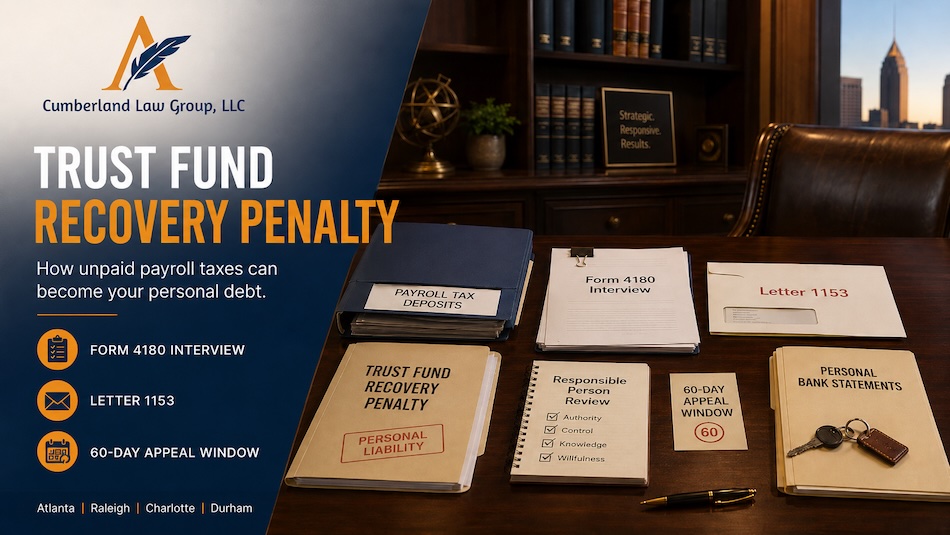
The tax attorneys at Cumberland Law Group, with offices in Atlanta, GA and across North Carolina in Raleigh, Charlotte, and Durham, represent business owners, officers, bookkeepers, accountants, and employees facing Trust Fund Recovery Penalty investigations, Form 4180 interviews, Letter 1153 appeals, and IRS payroll tax collection actions.
If you received a Form 4180 interview request, Letter 1153, or a call from an IRS Revenue Officer about unpaid payroll taxes, call Cumberland Law Group at (800) 960-5359 for a free consultation before you respond.
What the Trust Fund Recovery Penalty Is
The Trust Fund Recovery Penalty, often called the TFRP, applies to the “trust fund” portion of payroll taxes.
That phrase has a specific legal meaning. Trust fund taxes are the amounts withheld from employee paychecks, including federal income tax withholding, the employee’s share of Social Security, and the employee’s share of Medicare.
These amounts are called trust fund taxes because the employer acts as a collection agent for the government. The money never belonged to the business. It was withheld from employee wages and held in trust for the U.S. Treasury until deposited with the IRS.
The TFRP generally does not apply to the employer’s matching share of Social Security and Medicare. That portion is the business’s own obligation. The Trust Fund Recovery Penalty is focused on the withheld employee portion.
The IRS explains in its Trust Fund Recovery Penalty procedures that the penalty is designed to make responsible persons personally liable for unpaid trust fund taxes when the business does not pay them.
The amount is assessed dollar for dollar. If your business withheld $75,000 from employee paychecks across several quarters and never deposited it with the IRS, the potential TFRP exposure for each responsible person may be $75,000.
Who the IRS Considers a Responsible Person
The IRS does not automatically target whoever has the CEO title. A responsible person under Section 6672 is someone who had the status, duty, and authority to ensure payroll taxes were collected, accounted for, and paid over to the IRS.
The IRS looks at actual control over financial decisions, not just organizational charts. The practical question is this: could this person have directed the trust fund money to the IRS instead of somewhere else?
People who may be investigated or assessed as responsible persons include:
- Business owners and majority shareholders
- Corporate officers, including CEOs, CFOs, presidents, and vice presidents with financial authority
- Board members who participated in financial decisions
- Controllers and payroll managers with signature authority over accounts
- Bookkeepers who had check-signing authority and access to company bank accounts
- Outside CPAs or accounting firms with direct access to operating accounts and authority to make transfers
- HR managers with payroll system administrator access
- Lenders or creditors who took over financial decision-making during a workout
- Spouses of business owners who signed checks or controlled payments
The IRS Appeals guidance states that responsibility is a function of duty, status, and authority. Actual financial control matters more than title alone.
The reverse is also true. A nominal officer whose name appears in company documents but who had no real authority over which bills got paid may not be a responsible person. Ministerial employees who followed directions without exercising independent financial judgment may have defenses.
Title alone is neither sufficient nor required. Actual authority and actual control are what the IRS must establish.
Willfulness: What the IRS Needs to Prove
Responsibility is one element. Willfulness is the second. Both are required for a Trust Fund Recovery Penalty assessment to hold.
Willfulness does not require bad intent, fraud, or deliberate tax evasion. The IRS standard is lower. It can include intentionally disregarding a known legal duty or being plainly indifferent to the requirements of the law.
Using available funds to pay other creditors when the business cannot pay employment taxes is one of the most common indicators of willfulness.
This is also one of the most common patterns in struggling businesses: rent gets paid, suppliers get paid, net wages go out to employees, but payroll tax deposits are skipped because the account is short.
When a business owner or financial decision-maker knows payroll taxes are not being deposited and continues authorizing other payments, the willfulness element may be substantially met. The IRS does not need to prove the person wanted to steal the money. It needs to prove the person knew the obligation existed and chose to pay others instead.
Facts the IRS may treat as willfulness indicators include:
- Continued payment of net wages while tax deposits were not made
- Payment of rent, suppliers, lenders, or other creditors while payroll tax deposits were skipped
- Prior IRS notices about missing deposits that went unresolved
- Receiving IRS correspondence and not responding
- Active business operations continuing for multiple quarters while payroll tax liabilities accumulated
If the facts are more complicated, such as another officer concealing the issue, a payroll provider failing to make deposits, or a person lacking access to tax deposit information, those facts need to be developed before the IRS finalizes the assessment.
Multiple Responsible Persons Can Be Assessed for the Same Payroll Taxes
One of the most surprising features of the TFRP is that the IRS can assess multiple people for the same unpaid trust fund taxes.
Each responsible person may be assessed the full 100% of the trust fund balance, not a proportional share.
If a business has $120,000 in unpaid trust fund taxes and the IRS determines that three people were responsible, the owner, the CFO, and the outside bookkeeper could each receive a proposed assessment for $120,000.
The IRS can collect the total only once. But it may pursue any one responsible person for the full amount. If only one person has assets the IRS can reach, that person may pay far more than their perceived share of the problem.
A federal right of contribution may exist, meaning one responsible person who pays more than their proportionate share may pursue reimbursement from other responsible persons. In practice, that often requires separate civil litigation.
This creates serious risk for businesses with shared financial authority. An employee, controller, payroll manager, bookkeeper, or outside accountant may face the same IRS collection machinery as the owner if the IRS concludes they had sufficient authority and willfulness.
The Revenue Officer Investigation: What Actually Happens
When a business has unpaid payroll taxes and the account escalates, the IRS may assign a Revenue Officer. The Revenue Officer’s job is to collect the debt and investigate potential personal liability.
The investigation centers on Form 4180, Report of Interview with Individual Relative to Trust Fund Recovery Penalty or Personal Liability for Excise Taxes.
The Revenue Officer conducts this interview by phone or in person and fills out the form based on the taxpayer’s answers.
Form 4180 asks about:
- Personal identifying information and your role in the business
- Financial institutions used by the business
- Corporate structure and ownership
- Who had authority over payroll, accounts, and tax deposits
- Who signed checks or authorized electronic transfers
- When you first became aware of the unpaid taxes
- What other creditors were paid during the same period
The form is structured to establish the two legal elements of Section 6672: responsibility and willfulness.
Nearly every question is designed to show either that the person had control or that the person knew about the unpaid payroll taxes and chose other payment priorities.
IRS procedures recognize a taxpayer’s right to have an authorized representative present during the interview. A Revenue Officer generally must suspend the interview if the taxpayer states that they want to consult with a representative.
A casual answer, such as “I signed checks sometimes when the owner was out of town,” can become significant if the IRS uses it to infer financial control.
Attending a Form 4180 interview without preparation, without representation, and without understanding which answers may open the door to personal liability is one of the most consequential mistakes a business owner, employee, bookkeeper, or accountant can make.
If a Revenue Officer has requested a Form 4180 interview, call Cumberland Law Group at (800) 960-5359 before the interview takes place.
Letter 1153: The 60-Day Window You Cannot Miss
After the Revenue Officer completes the investigation, if they recommend a Trust Fund Recovery Penalty assessment, the IRS sends Letter 1153: Proposed Assessment of Trust Fund Recovery Penalty.
Letter 1153 usually arrives with Form 2751, Proposed Assessment of Trust Fund Recovery Penalty.
Do not sign Form 2751 without legal review. Signing it may constitute agreement to the assessment and can trigger collection action against personal assets.
Letter 1153 generally gives the taxpayer 60 days to appeal, or 75 days if the letter is addressed to someone outside the United States. That deadline runs from the date of the letter, not from the date it is received.
Within that window, options may include:
- Filing a written protest with the IRS Independent Office of Appeals
- Requesting informal review with the Revenue Officer early in the process
- Considering Fast Track Mediation if appropriate and if the Revenue Officer agrees
IRS procedures make clear that a taxpayer considering Fast Track Mediation must still protect the Letter 1153 appeal deadline. If mediation does not resolve the case and the formal appeal was not preserved, the case may move forward to assessment.
Missing the 60-day appeal window without action allows the IRS to assess the penalty as a personal tax debt.
Once assessed, the IRS can pursue collection against the individual personally through a federal tax lien, bank levy, wage garnishment, and other collection tools.
The 60-day window is one of the most important procedural protections available to a proposed responsible person. Losing it does not eliminate every option, but it usually makes the case harder and more expensive.
Why Bankruptcy Usually Does Not Solve the TFRP
Business owners who close a failing company sometimes assume that personal bankruptcy will eliminate the Trust Fund Recovery Penalty along with other debts.
That assumption is usually wrong.
Trust fund taxes are priority tax debts and are generally not dischargeable in bankruptcy. The TFRP may follow the responsible person through business closure, through the business’s own bankruptcy, and through personal bankruptcy.
The penalty may survive for the IRS’s standard collection period after assessment. During that time, the IRS can file liens, levy accounts, garnish wages, and pursue collection from future income.
A business owner who closes a company, starts a new one, and draws a salary years later may still face IRS collection on a TFRP from the defunct business.
That is why pre-assessment defense is so important. Challenging the responsible person determination or the willfulness finding before Letter 1153 becomes final is usually more valuable than trying to resolve the debt after assessment.
Trust Fund Recovery Penalty Defenses That May Work
Not every proposed TFRP assessment is legally correct. A Revenue Officer’s recommendation may be based on an incomplete interview, misunderstood authority, missing documents, or incorrect assumptions about who controlled payment decisions.
Defenses may include:
Challenging Responsible Person Status
If a person’s title suggests authority but their actual duties were ministerial, the responsible person element may not be met.
For example, a bookkeeper who processed payments only when directed, without independent authority to decide which creditors were paid, may have a defense.
Challenging Willfulness by Quarter
Willfulness should be analyzed by tax period. A person who joined the company after the unpaid quarters, or lost authority before certain quarters were missed, may not be responsible for every period included in the proposed assessment.
Challenging Knowledge
If the person genuinely did not know payroll taxes were unpaid, because another officer concealed the problem, a payroll provider was supposed to handle deposits, or the person lacked visibility into tax deposit status, the willfulness element may be contested.
Challenging the Form 4180 Interview Record
If the Form 4180 interview was not conducted properly, if the taxpayer’s answers were mischaracterized, or if the Revenue Officer drew conclusions not supported by the record, those problems can be raised in an appeal.
Offer in Compromise Based on Doubt as to Liability
After assessment, an Offer in Compromise based on doubt as to liability may challenge whether the TFRP was correctly assessed. This is different from an installment agreement because it contests the legal basis for the assessment rather than simply the ability to pay.
If the IRS has already assessed the penalty, you may also need to evaluate IRS appeal rights, collection alternatives, or refund litigation options.
Georgia and North Carolina Business Owners: Why This Matters Locally
Trust Fund Recovery Penalty risk is common in businesses that experience rapid growth followed by a cash crunch.
Businesses in Atlanta, Charlotte, Raleigh, and Durham that expand payroll quickly in response to a contract, project, or growth opportunity may find payroll deposit obligations outpacing available cash.
The temptation to defer the IRS deposit while paying rent, materials, suppliers, net wages, or lenders is exactly the pattern the IRS targets.
By the time the business owner addresses the problem, multiple quarters of trust fund liability may have accumulated, a Revenue Officer may already be assigned, and the personal liability investigation may already be underway.
Outside financial professionals should also be careful. Accountants, bookkeepers, payroll managers, and controllers with account access, transfer authority, or payment control may be pulled into the investigation even if they were not owners of the business.
Frequently Asked Questions About the Trust Fund Recovery Penalty
Can the IRS assess the Trust Fund Recovery Penalty against more than one person?
Yes. The IRS may assess the full amount of unpaid trust fund taxes against multiple responsible persons simultaneously. The IRS can collect the balance only once, but it may pursue any responsible person for the entire amount.
What happens if I receive Form 4180?
Form 4180 is part of the IRS Revenue Officer investigation process. The interview focuses on whether you were a responsible person and whether any failure to pay payroll taxes was willful. Statements made during the interview can significantly affect a future TFRP assessment.
How long do I have to appeal Letter 1153?
Letter 1153 generally gives you 60 days from the date of the letter to appeal, or 75 days if the letter is addressed outside the United States. Missing the deadline allows the IRS to assess the Trust Fund Recovery Penalty and begin collection against personal assets.
Can bankruptcy eliminate the Trust Fund Recovery Penalty?
Generally no. Trust fund tax liabilities are usually non-dischargeable and may survive both business and personal bankruptcy proceedings.
Schedule Your Free Consultation with Cumberland Law Group
If you received a Form 4180 interview request, Letter 1153, or any communication from a Revenue Officer referencing unpaid payroll taxes or trust fund liability, the time to involve representation is before the interview and before the 60-day appeal window closes.
Cumberland Law Group represents business owners, officers, bookkeepers, accountants, and outside financial professionals in Georgia and North Carolina facing TFRP investigations and proposed assessments.
We handle Revenue Officer representation, Form 4180 interview preparation, Letter 1153 appeals, IRS collection defense, and post-assessment litigation in federal court.
Free consultations are available at our offices in:
The Trust Fund Recovery Penalty can follow you personally for years after the business closes. Contact us while options remain open.
Call Cumberland Law Group at (800) 960-5359 for a free consultation, or contact us online and we will call you back.
This page is for informational purposes only and does not constitute legal advice. Contact Cumberland Law Group directly for guidance specific to your situation.